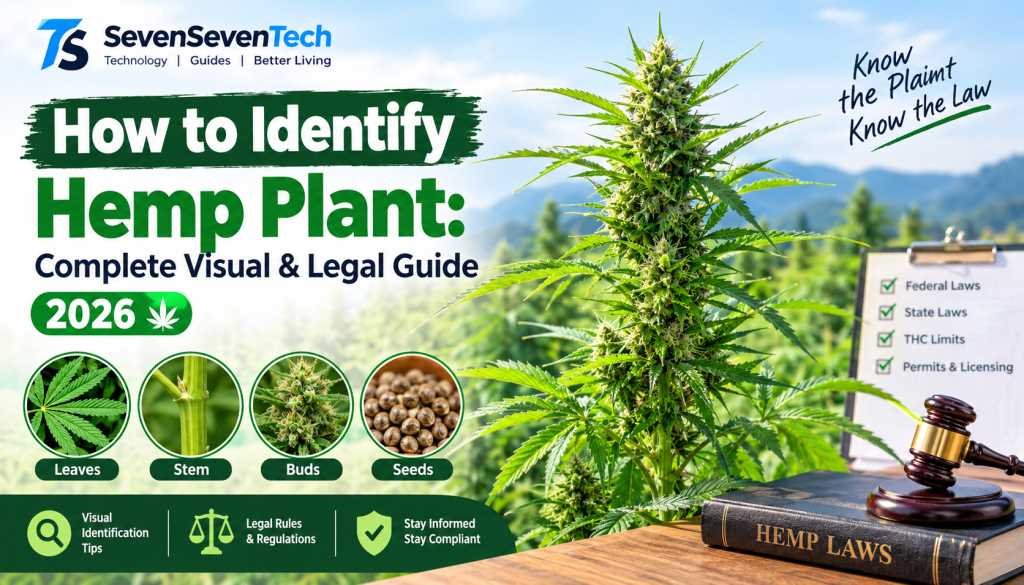
How to Identify Hemp Plant: Complete Visual & Legal Guide 2026
If you are searching for how to identify hemp plant, you are in the right place. This article gives a simple, step-by-step review of the key traits, legal context, and common mistakes. It is written for readers in India and beyond who want clear facts without jargon. At SevenSevenTech.in, we aim to make complex topics easy to understand for everyone.
What Is Hemp? A Quick Botanical Overview of Cannabis sativa L.
Hemp is a variety of the species Cannabis sativa L. It is grown mainly for fiber, seeds, and low-THC extracts like CBD. Botanically, it is an annual herb with a tall, straight stem. The leaves are palmately compound, meaning they split into several leaflets from one point. Most hemp types show 5 to 7 serrated leaflets per leaf, though the count can range from 3 to 9. The plant grows fast in warm seasons and can reach several meters in height when planted for fiber.
Legal Definition vs. Visual Reality: Hemp, Marijuana, and the 0.3% THC Rule
Legally, “hemp” means Cannabis sativa with no more than 0.3% delta-9 THC on a dry-weight basis. “Marijuana” refers to types above that limit. This rule is used in many countries to separate legal hemp from controlled cannabis. In India, the NDPS Act defines “cannabis plant” broadly as any plant of the genus Cannabis, so local rules and permissions matter a lot. Visual inspection alone cannot confirm THC levels. Two plants can look alike but differ in chemistry. That is why field clues help, but lab tests decide the legal status. Core Morphological Features: How to Identify Hemp Plant in the Field
When you ask how to identify hemp plant, start with the whole-plant shape. Fiber hemp usually grows tall and slender, with a single main stalk and few side branches. The canopy often looks sparse, with most leaves near the top. Stems are stout and canelike, light green when young and smoother as they age. In dense plantings, hemp forms a uniform, bamboo-like stand. These growth habits are strong hints that you are looking at hemp, not a bushy, high-THC type.
Leaf Structure Deep Dive: Leaflet Count, Shape, and Serration Patterns
Leaves are the most useful clue for how to identify hemp plant in the field. Hemp leaves are palmately compound, with leaflets radiating from one point on the petiole. Each leaflet has a serrated (toothed) edge and a pointed tip. Lower leaves may be opposite on the stem, while upper leaves are alternate. Fiber hemp often has narrower leaflets than marijuana types. If you see 3–9 serrated leaflets in a palmate pattern, you are likely looking at Cannabis sativa. Count the leaflets, check the serration, and note the arrangement to build confidence.
Stem and Growth Habit: Height, Branching, and Canopy Clues
Stem and branching tell a clear story. Hemp grown for fiber is kept tall and unbranched by planting densely. This reduces side shoots and pushes growth upward. Stems are light green to green-gray, with fine hairs when young that fade with age. In contrast, marijuana types are spaced apart, pruned, and trained to branch heavily for flower production. If you see a tall, straight, lightly branched plant in a dense field, it fits the hemp profile. If the plant is short, bushy, and heavily branched, it likely targets flower yield.
Flowers and Sex Expression: Recognizing Male vs. Female Hemp Plants
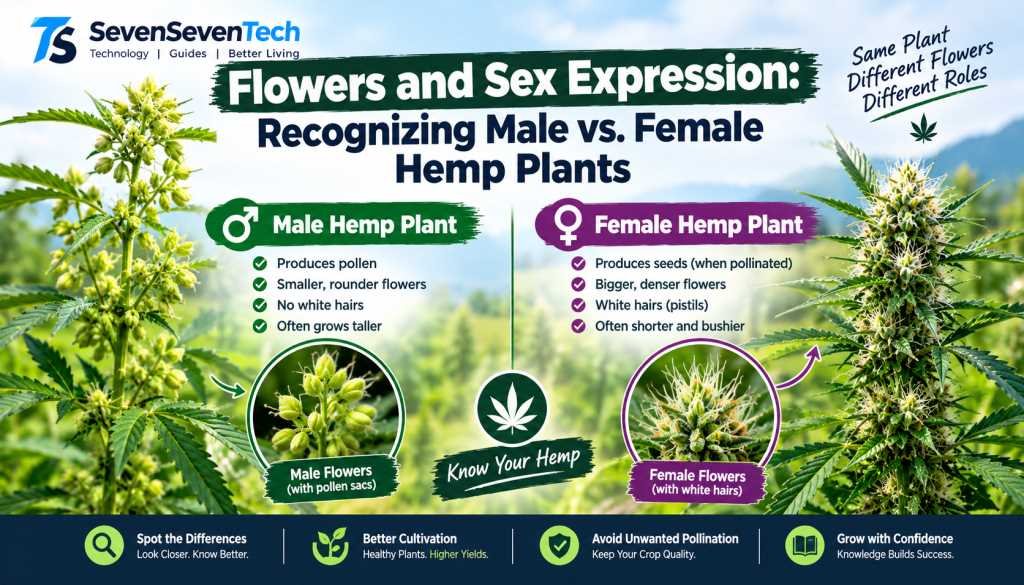
Hemp is dioecious, meaning male and female flowers grow on separate plants. Male plants are skinnier and develop small pollen sacs at the nodes. By late season, male flowers can turn yellow or brown as they shed pollen. Female plants form elongate, spikelike clusters without large, resinous buds. Fiber hemp fields often have both sexes, but some seed or CBD programs manage sex ratios carefully. When learning how to identify hemp plant, note that flowers are small and greenish-yellow, not the dense, sticky clusters seen in high-THC cannabis.
Hemp vs. Marijuana: Appearance, Cultivation Style, and Resin Differences
Though both are Cannabis sativa, hemp and marijuana differ in look and farming style. Hemp is taller, thinner, and less branched, with a focus on stem and seed. Marijuana is shorter, bushier, and heavily branched, with a focus on flowers. Hemp fields are dense; marijuana plots are spaced to boost light and air for buds. Resin production is another clue. Marijuana types often show visible resin glands and strong aroma on flowers. Fiber hemp usually has lower resin and milder scent. These patterns help when you ask how to identify hemp plant in real-world settings.
Comparison Table: Hemp vs. Marijuana vs. Sunn Hemp
| Feature | Hemp (Cannabis sativa, low THC) | Marijuana (Cannabis sativa, high THC) | Sunn Hemp (Crotalaria juncea) |
|---|---|---|---|
| Primary use | Fiber, seed, CBD | Flower/THC products | Green manure, cover crop |
| Plant height | Tall (2–5 m), slender | Shorter, bushy | Medium height, branching |
| Leaf type | Palmate, 5–7 serrated leaflets | Palmate, often broader leaflets | Simple/trifoliate, not palmate |
| Flowers | Small, greenish-yellow spikes | Dense, resinous flower clusters | Bright yellow, pea-like flowers |
| Growth pattern | Dense planting, few branches | Spaced, heavily branched | Open stand, legume growth |
| Resin/aroma | Lower resin, milder scent | High resin, strong aroma | No cannabis-type resin |
| Legal status (India) | Regulated; licenses needed | Controlled under NDPS | Legal agricultural crop |
This table gives a quick reference when you compare plants while applying the how to identify hemp plant framework.
Common Look-Alikes in South Asia: Sunn Hemp, Weeds, and Misidentifications
In India and nearby regions, some plants get confused with true hemp. Sunn hemp (Crotalaria juncea) is a common cover crop with bright yellow, pea-like flowers. Its leaves are not palmately compound like Cannabis. Instead, they are simple or trifoliate, depending on the stage. Other broadleaf weeds may have lobed leaves that mimic young cannabis. The key is to check for palmate 5–7 serrated leaflets, the canelike stem, and the flower type. If you see yellow legume flowers, it is sunn hemp, not Cannabis sativa.
Regional Context: Hemp Cultivation and Regulations in India
India’s rules on hemp are strict under the NDPS Act, which defines “cannabis plant” broadly. Some states allow licensed cultivation for fiber or seed under specific programs, but permissions vary. If you are a farmer or researcher, check state policies and obtain written approvals before growing or sampling. For the public, the safest path is to treat any Cannabis plant as regulated until proven otherwise by a lab. When discussing how to identify hemp plant in India, always pair field ID with legal awareness.
Step-by-Step Field Checklist: A Practical Guide for Farmers and Enthusiasts
Use this quick checklist when you need to decide how to identify hemp plant on site.
- Leaf check: Look for palmate leaves with 5–7 serrated leaflets.
- Stem check: Note a tall, straight, canelike stem with few branches.
- Canopy check: See if the stand is dense and bamboo-like.
- Flower check: Find small greenish-yellow spikes (female) or pollen sacs (male).
- Pattern check: Confirm planting density and overall growth habit.
- Look-alike check: Rule out sunn hemp and other weeds by flower and leaf type.
This list gives a fast, structured way to apply the how to identify hemp plant logic in the field.
Photo Gallery and Visual Cues: What Real Hemp Plants Look Like
Visual learning speeds up ID skills. Real hemp shows tall, narrow plants with most foliage near the top. Leaves display a clean palmate pattern with sharp serrations. Stems look smooth and jointed, like thin bamboo. Flowers are modest and not overly resinous. When you study photos, focus on the overall silhouette, leaf arrangement, and flower clusters. These cues reinforce the written steps for how to identify hemp plant and reduce confusion with bushy, high-THC types.
Tools and Tests: From Field Keys to Lab Confirmation (Fast Blue, UV-Vis, DART-MS)
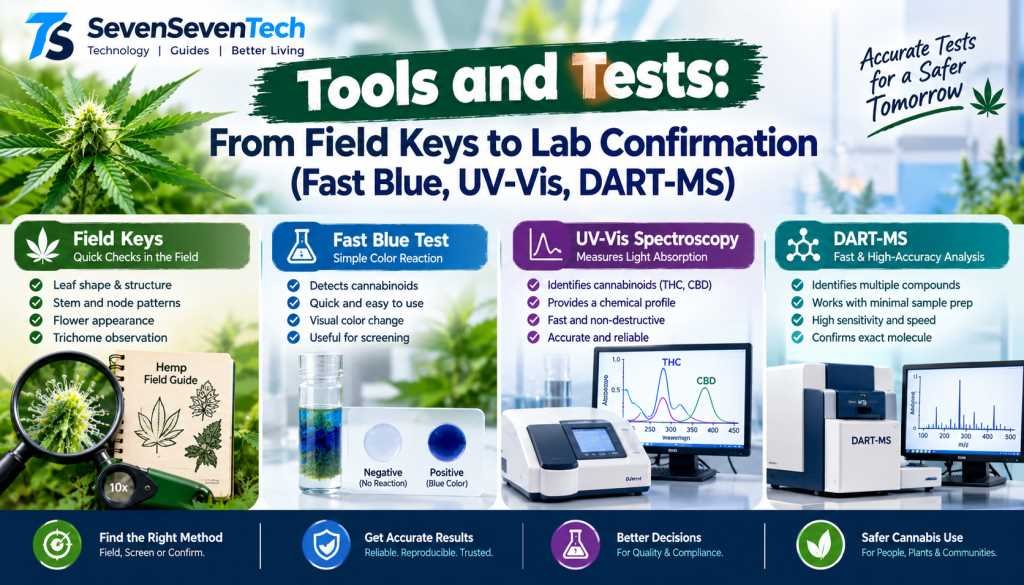
Field clues are useful, but chemical tests confirm THC levels. The Fast Blue BB (FBBB) color test reacts with cannabinoids and can hint at hemp vs. marijuana types. It forms different colors with THC and CBD, helping presumptive ID. The 4-AP test adds another color cue based on THC/CBD ratios. For stronger proof, labs use UV-Vis spectroscopy or DART-MS to profile cannabinoids. If legal status matters, send samples to an accredited lab. This is the gold standard when you ask how to identify hemp plant with certainty.par.nsf+3
Myth-Busting: 7 Misconceptions About Identifying Hemp Plants
Many myths cloud the topic of how to identify hemp plant. Some say leaf shape alone decides legality. That is false; THC content decides, not looks. Others claim all Cannabis smells the same. In reality, aroma varies by type and growth stage. A third myth is that hemp never has resin. Fiber hemp has less, but it can still produce some. Another error is treating sunn hemp as true hemp; they are different species. Some believe field ID is enough for legal cases. It is not; lab analysis is required. Others think all tall cannabis is hemp. Height helps, but it is not proof. Finally, many assume India allows free hemp farming. It does not; licenses and state rules apply.
Safety, Compliance, and When to Seek Expert Verification
Safety and compliance come first. If you find an unknown Cannabis-like plant, avoid handling large amounts and do not consume any part. In India, unauthorized possession can lead to serious legal trouble. For farms, keep records of seed sources, planting dates, and permissions. If there is any doubt about THC levels, seek expert verification from a recognized lab. This protects you, your land, and your community. When in doubt, remember: field ID guides, lab tests decide.
FAQ: Quick Answers to “How to Identify Hemp Plant” Queries
Q1: Can I identify hemp by smell alone?
No. Smell varies and is not a legal test. Use leaf, stem, and flower clues, then confirm with a lab if needed.
Q2: Does hemp always have 7 leaflets?
No. Hemp usually has 5–7, but 3–9 is possible. Check the palmate pattern and serration, not just the count.
Q3: Is sunn hemp the same as true hemp?
No. Sunn hemp (Crotalaria juncea) is a legume with yellow flowers. True hemp is Cannabis sativa with palmate leaves.
Q4: How do I know if a plant is legal in India?
Visual ID is not enough. You need proper licenses and, for legal certainty, lab THC testing.
Q5: What is the fastest field method?
Use the 6-step checklist above. For chemical hints, trained users may apply FBBB/4-AP tests, but lab confirmation is best.
Conclusion: Confident Identification with the Right Context
Learning how to identify hemp plant is about combining simple field clues with smart legal choices. Focus on leaf pattern, stem shape, growth habit, and flowers. Rule out look-alikes like sunn hemp. Respect India’s rules and use lab tests when THC levels matter. With this approach, you can move from guesswork to confident, responsible ID.